Showing posts with label Inside Story. Show all posts

The story of how Dwarasamudra became Halebeedu

The villager gives me a vacant look when I ask him the route to Dwarasamudra, the 11th century capital of the Hoysalas. I try again and this time I add Hoysala capital and temple as well. He responds with a toothless grin and rapidly gives directions in Kannada to my driver.

My search for Dwarasamudra however takes me to the portals of a famous tourist site, the 12th century  Hoysaleshwar temple in modern day Halebeed .To the many tourists here, Halebeed is the capital , but Dwarasamudra is still alive in the ruins scattered in the old village

I walk beyond the bylanes of the temple into the old village where Dwarasamudra comes alive in the ruins . An  inscription here speaks of a battle fought here against the Kalachuriyas by Veera Ballalla II. A few tourists go boating on the lake, which was once the foundation of Dwarasamudra, which means Entry by Ocean.

A rustic calls me over to see another inscription .It says the Hoysalas were ruling from Velapuri or Belur from  the banks of the Yagachi river. When Vinayaditya shifted to Dwarasamudra in the 11th century ,he built a canal to channelize water from Yagachi to the new capital. A tank was built and the Hoysaleshwar  temple was later constructed on its bank. “ And then , it was renamed as Halebeedu, meaning old abode, “ explains the villager as we walk together to see the ruins.

With the Bennegudda hill looking down on them, the remnants of the old city stood silently. A fortified palace and a pedestals of temples lie scattered. There is a Linga with some headless sculptures and some broken friezes  .This was the capital of a dynasty that once defeated the  Chola,  Chalukyas , Kadambas and Kalachuryas before being destroyed by internal strile and  ravaged by the Muslim invaders in the 14th century.
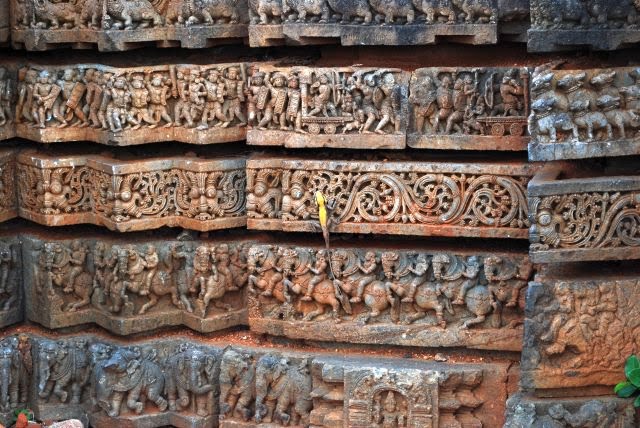
I sit  on the steps of the ruined temple and read about the saga about the dynasty’s end. Somewhere in the middle of the 13th  century, the Hoysala kingdom was divided between two brothers, Narasimha III who ruled from Dwarasamudra and Ramanatha from Kannanur. The brothers fought over Dwarasamudra even as Narasimha III’s son Veera Ballalla III came to the throne. He eventually became the last king of the dynasty as the final blow came in the form of Malik kafur, a general of Alauddin Khilji who invaded south in the 14th century.

The invaders forced Ballalla III to submit and looted him of 312 elephants, 20,000 horses besides jewellery.  Dwarasamudra was plundered as Ballalla fled to Belur. A few years later, the king returned and attempted to rebuild Dwarsamudra , but the Muslim onslaught continued. As Dwarasamudra was further destroyed, the king fled to Tiruvannamalai , but died in Madurai while fighting the invaders. It is said the cruel blow came when “ the captured king was slain and skinned , his skin was stuffed with straw and hung from the top of the walls from Madurai. “ Ibn Battuta, the Morroccon traveler who was in the court of Muhammad bin Tughluq, the reigning Sultan at the time records this as I put the book with a heavy heart.

Outside the air became solemn as twilight set in. As the dynasty ended , Dwarasamudra disappeared into the dusty annals of history . Halebeedu took over from  Dwarasamudra and found its place in another map – the tourist’s agenda. The lights came up at the Hoysaleswara temple as the last set of tourists posed for a picture against the monument  and grabbed a piece of history unknowingly with them. The sun may have set on the dynasty a 1000 years ago, but they made sure they left their glory behind in the temples they have built.

This was published in The Hindu, Metro Plus in my column, Inside Story. Coming up next - what to see in Dwarsamudra besides the famous Hoysaleshwara temple in Halebeedu.


~ Tuesday, September 7, 2010 0 comments

Inside Story - Nubra Valley, Ladakh

“ Just 20 minutes , “ warns Dorjee , my driver as we finally reach the summit at 18380 feet  . Stepping out into the cold, I realize that Khardungla pass looks like any other tourist destination . Patches of snow cover the dry mountains.  The shutterbugs are all around, capturing the moment for posterity. Looking down , I see the treacherous roads snaking their way up, bringing a group of adventure tourists on bikes and bicycles . But Dorjee’s warning , I realize , is real. Although I have no trace of altitude sickness, my head is rather giddy with excitement. I look hurriedly for a dry toilet and then continue with my journey. 


The starkness of the landscape becomes more pronounced as we drive down one of the ancient trading routes.
However as we plunge downhill, the landscape changes dramatically. Dorjee  says we are lucky. “ The road was closed last week due to heavy snow.” We look around and see the Karakoram range around us, the Siachen glacier in the distance and the river Shyok flowing beside us.  


Some desert flowers bloom here and there , as  Dorjee calls it Ldumra or his valley of flowers . The Shyok joins the Nubra or the Siachen river and creates a lush valley here filled with apricot and apple orchards. The altitude drops suddenly and we are amidst sand dunes.  Bactrian camels  make a surreal appearance here against the setting sun , as we stop by to take in the moment.


We head to Diskit ,  where a 14th century monastery awaits us. Dorjee gives us a brief introduction about the various orders practiced by the lamas here. Most monasteries he says  are either founded by the Drug-pa or the red hats or the Gelug-pa or the yellow hats . Diskit monastery was  founded by Changzem Tserab Zangpo, a disciple of Tsong Khapa, founder of Gelug-pa order. 


We climb up the stairs, a bit breathless and see a mighty Maitreya , some fierce guardian deities and a wonderful fresco of the Tashilhunpo Gompa of Tibet. A huge drum catches our attention. Dorjee explains that the monastery celebrates the  Festival of the Scapegoat or Desmochhey with a mask dance that depicts the victory of good over evil . He then goes on to narrate the story of a Mogul demon who haunts this Gompa even after he was killed. Locals believe that the Gonkhang or the temple of the guardians still houses his wrinkled head and arm .


I shiver a bit, more out of the cold and head to Hundar, a charming hamlet by the river side with mani walls and chortens scattered all around.  The capital of the ancient Nubra kingdom, Hundar houses the Chamba Gompa and is probably one of the last few Indian villages before the Pakistan border. Small streams and waterfalls make it  the only oasis in this cold desert. I walk up to a prayer wheel , probably the last in the Indian border and wish for peace.

To read more of the story , click here

~ Sunday, September 5, 2010 1 comments

Birth of a hill station - Chail


Almost every hill station in India - be it Shimla  or Darjeeling tell the same story. Lush and plentiful in summer with snow kissed conifers carpeted on their slopes in winters, these towns have been plucked   out of nature by the British. The quaint names, a sleepy railway station, an ancient church , a club and the palatial bungalows are all reminiscent of the old world charm. 

 If you take a leisurely walk down the malls and markets of these towns, they still smack of the colonial legacy. These hill stations were dubbed the summer capitals of the Britishers who lorded over them for several  years. And yet, one little hill station stands apart from the rest, defying the colonial hangover . It owes its existence on the political and tourist maps to an Indian ruler who made it his summer capital. This is the story of Chail , a town barely 45 kms from Shimla in Himachal Pradesh .

Located at a higher altitude than Shimla, the story goes that the Maharaja Bhupinder Singh of Patiala made Chail his summer capital when the British barred him from entering  Shimla. Although the conflict was not on military grounds, the story goes that the Maharaja was romancing a daughter of Lord Kitchener, who was then the Commander in Chief of the British army. 

The Maharaja decided to give the British a fitting reply and went on to create his own summer capital in Chail.  He first built a palace near Khandaghat  called Chail View Palace and then  built a road to Chail and finally his own summer retreat in this little town surrounded by deodar forests. Ironically Chail itself had been gifted to the Maharaja by the Britishers earlier .

The Maharaja was an avid cricketer and had captained many an Indian team besides playing several first class matches himself .  He left Chail a trophy – a cricket ground which has the highest ever pitch located at 2140 metres and it doubled up as a polo ground as well.

Like many Indian towns , Chail has its own share of myths and legends. We visited a temple dedicated to a saint, Sidh Baba built on a hillock by the king. The locals believe that the king had planned to build his palace here earlier , but the seer had visited him in his dream and asked him to choose another location.

Nevertheless, the Maharaja couldn’t have found a better place to create his summer capital. With the Himalayas in the background and the valley beneath,  the river flowing down and three dense hillocks covered with deodar forests, Chail looked every bit a royal capital. The lights of Shimla and Kasauli came up  as I stood there for awhile watching the sun went down. Chail had indeed come a long way from an idyllic hamlet to a royal seat and now a tourist resort .
.  

This was another of my Inside Stories, published in The Hindu - Metro Plus 


~ Monday, July 5, 2010 0 comments

Gangaikondacholapuram - an ancient Chola capital

The sculpture calls out to me. Carved in stone is a story of a devout cowherd called Chandesa who worships an icon of Shiva on sand and anoints it with milk. His father angrily strikes him and Chandesa retaliates . His staff turns into an axe chopping off his father’s legs, just when Shiva lands on the scene and accepts him into his fold. When the guide finished his narration, it seemed to be just another tale from Indian mythology; but it did not end there.

“ See the sculpture carefully , the cowherd is a prince and the prince is the great Rajendra Chola 1,” he said explaining that this could be an allegory . Engraved in stone is the coronation ceremony of Rajendra Chola 1 graced by the Gods - Shiva and Parvati as the prince dedicates all his laurels to them .The sculpture that depicts this celebrated moment is the famous Chandesanugraha murthi panel from the Brihadeshwara temple.

I am in Gangaikondacholapuram,the long lost capital of Rajendra Chola 1 which has mysteriously disappeared leaving behind this mammoth temple. This was the town that once ruled all of India upto the Gangetic plain and also Srilanka, Maldives, Malyasia and Indonesia. When Rajendra Chola 1 conquered the Gangetic plain, he wanted to portray to posterity that he was probably greater than his father Raja Raja Chola 1 who had immortalised himself with the Big Brihadeshwara temple in Thanjavur. So he built another Brihadeshwara temple in a new found capital called Gangaikondacholapuram. However he did not complete the temple. And he finally ensured that his father’s temple was bigger than his. There were no answers to this sudden change of heart. Probably the panel was a clue to the sudden decision says my guide.

The towering 180 feet tall Vimana seem to touch the sky announcing its existence in this otherwise dead capital . A majestic Nandi obstruct our gaze. A few gardeners are tending to the lawn while we soak in the ambience. Various forms of Shiva captured in different moods stand out in the artistic mosaic. A giant lion shaped sculpture called Simhakinar in the form of the Chola emblem stares at you .

” This is the way the defeated kings used to go down and pour the water they brought down from the Ganga,” says the guide. I peer down and see a flight of steps leading through a tunnel below into a huge well filled with murky water. Rajendra built another huge reservoir which was about 22kms long and elephants were used by the armies to bring the water from the river. “He had brought back more than 1000 pots of holy Ganga water and performed the Kumbabhishekam,” adds my guide.

We move on looking for the palace and reach a small mound close by called Malligai medu near a small village called Ulkottai An empty spectacle of sand and rocks greet us. Recent excavations have unearthed some priceless treasures which are now sheltered in a small hut near the temple complex where the State ASI’s museum remains. A Buddha stands on the stony pavement along with some banana vendors as we enter the hut. Smiling silently at me is the king himself from a painting against the wall. The image stays with me as we drive down the highway.
This was published in the Inside Story, my column in Metro Plus.

~ Saturday, July 3, 2010 0 comments

Doddamakkali - A tryst with the River Cauvery

We were at Kabini yesterday and today, lets soak a bit in the Cauvery at Doddamakkali, which is more than just a fishing camp. This story was published in Jungle tales, a magazine brought out by Jungle Lodges on their 30th anniversary. A shorter version was also published in my column, Inside Story in The Hindu


My car jerks violently for a moment as the mud road brings it to a grinding halt .In a moment, the entire landscape is filled with a flock of birds .And that’s when the river Cauvery presents itself, looking deceptively quiet as it meanders below me. Descending from the Shivasamudra falls, the river flows here, bordered by the rolling green hills. I continue my journey and trudge along for a while when a nervous jackal rushes past me into the forest. Finally, I enter the portals of the Doddamakkali camp as the resident grey hornbills greet me.

Doddamakkali is not just a river bed, but a beach with pristine white sands. Rocks stand out with their reflections sparkling in the blue green waters. A lesser fishing eagle calls , but it remains hidden in the trees. “We just spotted some otters this morning,” says Karthik, the manager as I sip some lime juice. A langur pauses and sizes us up before carrying on. Elsewhere monkeys freely roam around the camp . As my coracle is getting ready, I see the brahminy kite dive into the waters.


If you are at Shimshapura, Dodamakkali is the first among the fishing camps as it is upstream. Bheemeshwari lies just 6 kms from here on the river and Galibore is further downstream. This is the course of the Mahsheer, one of the best sport fish sought after by both anglers and poachers. However, I was in no mood to fish, but we set sail to see some jelly fish which had resurfaced in the pools caused by the rapids .

The sun slips behind the clouds. Cormorants open out their wings and strike a pose, while the river terns fly around us. A crocodile basks on a rock. Surrounded by forests, the Cauvery divides them into two ranges – Malavalli and Kollegalla. The forests come alive with elephants, leopards, wild pigs, mongoose, sambhar, spotted deer , grizzled giant squirrel among others.

We sail alongside the Malavalli range where a hillock stares us in our face.”You would’ve passed it enroute,” adds Karthik following my gaze.”You will also find a similar one and that’s why its called Anna Thamma Gudda .”
We are suddenly beckoned by the forest officials from the Kollegalla bank and we sail towards them. The RFO tells me that they are planning to have a shed with guards here for conservation and protection. The forest is dense as we stroll around . “Have you tasted the pickle made of makkali root?” he asks as we wait for the boatman. I nod, remembering the unique taste.” This place is called Doddamakkali because of these plants that used to grow in plenty here ..now you find then in Chikkamakkali .” he adds.

We discuss poaching and the camp has quite a few former poachers who have now been employed in the camp.” You must meet Soma Naik who had a case against him filed by his own brother as he used to be a poacher once. Now, both of them work here and are into conservation,” he adds. The water gets deeper as the currents become stronger. The boatman deftly strokes the river and finally anchors the coracle near the rocks. He warns me to watch out for snakes , mainly cobras and pythons . We climb the rocks and reach a small pool where tiny jelly fish swim deep below. We almost lie flat on our stomachs and peer right into the waters to catch a glimpse and with great difficulty see tiny rings floating right inside .

As the sun’s rays light up the pool, we catch a sight of them, before they magically disappear deep into the pool.I sit on the rocks and look up at the sky .The blue is fast turning grey. A few drops of rain shower on us. A pied wagtail lands on a rock. A white breasted kingfisher perches on the branch looking for its next meal. A green eater looks away. We circle a bit on the coracle and set sail towards the camp, listening to the shrill cry of the red wattled lapwing, “ Did you do it ?”

Fact file
Doddamakkali is one of the most remote fishing camps in the river Cauvery , barely 8 kms from Shimshapura .A beautiful landscape littered by rocks , the camp is located on the banks of the river on the Malavalli reserve. The patron Goddess Kali lends her name to the hamlet and there is a small shrine on the mud road leading to the camp.


The camp has about eight tents with attached toilets. The ambience is natural as there is less electricity here and the camp runs on generator. So, your tents will be lit with an electric lantern with fans at night. A torch is a must have if you are headed here .

Activities include trekking, birding, fishing and coracle rides. You can try beach volley ball as well.


Best season :
The months between September and February will be the best time to visit as its also ideal for birding and to see jelly fish. Angling starts here at the onset of early winter as well. Summers can get very warm and humid there.

Getting there
Doddamakkali is approximately 140 kms from Bangalore. You can either take the Kanakpura route or the Maddur-Malavalli road. If you are taking the Kanakpura road from Bangalore, reach Halgur and from there drive down to Shimshapura village. There is a gate with a watchman there. You make an entry there and then drive down the 8 kms of mud road that reaches the camp. The last km is a bit tricky, so ensure that your vehicle is in good shape.
If you are driving via Maddur, take a deviation towards Malavalli and Kollegal . You would reach Shimsha Hydro electric project. Follow the JLR board there until you reach the Shimshapura .

~ Friday, July 2, 2010 0 comments

Angadi - the birthplace of the Hoysalas


“Hoy Sala " ( Strike Sala ! ) said the guru Sudatta Muni to his student , Sala who was in an armed combat with a tiger . The beast had just attached the duo who were immersed in rituals at a Durga or Vasantha Parameshwari temple in a village called Sasakapura or Sosevur. The student struck the animal in one blow, immortalizing himself and his victim . The guru was so pleased that he asked Sala to establish a kingdom and the Hoysala dynasty was established with Sosevur as the capital .
The story is believed to have happenned more than 1000 years ago. at Sasakapura or Sosevur which is today identified as Angadi, a small hamlet in Chikmagalur district in Karnataka The temple of the Goddess , along with the ruins of more temples and basadis is the only proof of this myth .The folklore however became so popular that every temple of the Hoysalas has this story carved in stone and it became the royal emblem of the dynasty.

We were in Malenadu or the hilly regions of Karnataka when we heard this story. This was not a pleasure trip, but a journey that took us down eons of history , a quest in search of folklores and myths that gave an identity to the Hoysala Dynasty .We were looking for a humble beginning of this dynasty which had ruled this region for over 400 years.

Our destination was Angadi, a small hamlet lost in the hills of Karnataka, enveloped by coffee plantations and lush green fields. Nestled in the Western Ghats, in South India in the heart of coffee country, this nondescript village was once the birthplace of a powerful dynasty which ruled South India thousands of years ago.
The meandering roads snaked around a green fabric of coffee plantations and dense forests. The leaves of the pepper crops curled around the silver oak trees. It had rained a bit but the afternoon sun was now shining in all its glory. The snowy white blossoms of the coffee plants glistened even further . The dusty hamlets interrupted this green mosaic as they emerged one after another . It was late afternoon and the roads were empty .

We stopped by at a small town, Janapura to have some tea and take in the fresh air.The directions were loud and clear. Angadi was a further seven kms away. In about ten minutes we were there. A small village with a few houses scattered here and there , a couple of shops, a lone bus stand and green fields. At first glance, it looked like just another hamlet lost to the world. And yet, it was the cradle of a dynasty that built beautiful temples and made several conquests . However to our eyes, there was nothing historic about it. And then we took a short stroll, wondering if we had indeed come to the right village. To prove us right, stood a faded old relic under the shade of a tree ..a Hoysala inscription . We were indeed on the right track.


Angadi in Kannada means shop, but we hardly found any shops around . Surrounded by coffee plantations and open fields, it seemed to be a sleepy market . We finally found a small shop and asked them the route to the “ Devasthanam “ meaning temple in the local lingo. A couple of hands pointed uphill which took us through a coffee plantation which led to mud roads which split into two. There was not a soul around. We followed the road going upward and encountered steep hairpin bends which curved through the coffee plantations and led us to the Durga or the Vasantha Parameshwari temple . And this was the setting of the origins of the Dynasty

The origin of Hoysalas
The Hoysalas were not born kings but they ruled for 300 years . They were natives of Malnad, Karnataka and were tribal chiefs who were subordinates of the Western Chalukyas. Some inscriptions show them as lords of the Male (hills) while some indicate that they were descendants of the Yadava clan. Historically though the first Hoysala family record is dated 950 and names Arekalla as the chieftain, followed by Maruga and Nripa Kama I (976) .


But the kings who shaped the dynasties were Vishnuvardhan and Veera Bhallalla who became independent from the Chalukyas .Vishnuvardhan established his supremacy by defeating the Cholas in Talakadu . Historians claim that the story behind the Hoysala crest is a symbolic interpretation of this victory as the tiger , a symbol of the Cholas is shown subdued by a soldier.

But today the Hoysalas are remembered for their patronage to arts along with their exploits on the battlefield – a baffling 1500 temples built in 958 centres, of which the two famous ones are Belur and Halebid which were the capital cities of the dynasty. However, hardly a 100 survive today. Our trail had taken us down to 25 villages including Angadi , the original capital of the empire, where it all began.

The Durga temple was renovated and was well maintained . It did not look like a typical Hoysala temple either , going by their style . A tall structure supported by pillars with sculptures stood close by. The priest explained to us that the temple, which has been renovated recently was the original temple where Sala had killed the legendary tiger.

The pillars he said were used as a swing to cradle the Gods during festivals. I had read that there was the ruins of a Chennakesava temple here similar to the Belur temple . We asked him where the ruins were and he told us to follow the roads that went below. We were told that there were three temples as well as basadis

The ruins of Angadi
The priest guided us and we followed the road below until we came to almost a deadend. There seemed to be a rugged path above as we climbed on the rocks that led us inside the coffee plantation. We saw a few basadis with some sculptures inside while a few were left wide in the open. It was silent except for some parakeets which were shrieking in excitement. We almost thought the place was to ourselves when we heard some voices .

We squinted through the trees and found some workers. We went down and climbed another path where the ruins of the three temples awaited us . The Chennakesava temple , along with Patalarudreshwara and Mallikarjuna lay absolutely in ruins..The structures were being laid by the ASI workers who had just begun restoring these temples. The idols and sculptures were kept safely, especially the Chennakesava which stood in all its glory in the glare of the setting sun. As the sun touched down, we sat a while on the broken pillars gazing at the strewn idols and wondering about the times when a dynasty was laying its foundation stone in a small village. It dawned on us at that very moment, that we had just walked into a historic moment.

Getting there - Angadi is 18 kms from Mudigere and 25 kms away from Belur and 260 kms from Bangalore The ideal route from Bangalore would be to reach Belur and take the Mudigere route . At Janapura, one needs to take a left and Angadi is 6 kms from the junction. You can also reach Angadi through Sakleshpur and Chikmagalur . Accomodation in the form of home stays and resorts is available at Hanbal, which is the closest town as well as Sakleshpur, Chikmagalur and Mudigere.

A shorter version of this story , focussed on the myth was first published in my column, Inside Story and then much later in Spectrum, Deccan Herald.

~ Wednesday, June 30, 2010 0 comments

Inside Story - Shivappa Nayaka Palace, Shimoga


At first glance it hardly looks like a palace. But on a second glance it does not seem like a saw mill either. To me , it looks like an exquisitely designed home , carved in rosewood, replete with a Mangalore tiled roof with wooden pillars, an open courtyard, two narrow staircases leading to a hall flanked by rooms and a balcony .

It is well past noon and I am in the Shivappa Nayaka palace in Shimoga or Shivamogga, a town located on the banks of the river Tunga in the Malenadu heartland . We happen to be the only tourists in this sprawling palace. The staircase leads us upstairs and we enter the main durbar or the balcony of the palace . Looking out into the vast expanse , we see that the well manicured lawns have turned into a veritable art gallery with ancient sculptures scattered around them.


We wait patiently for the watchman to finish his lunch and take us on a guided tour. The original palace he says was built by Hiriya Venkatappa Nayak of the Keladi Dynasty in the 16th century. The Vijaynagar empire was declining and the Keladi Nayaks, who were ruling as chieftains under them , had slowly emerged emerging on their own. A local battle fought here between the Nayaks and the Palegars resulted in the former’s victory and hence a fort and a palace were built here. The victory was however shortlived. Soon, Adil Shah of the Bijapur Sultanate destroyed it after a bitter battle and it was later rebuilt by Shivappa Nayak in the Indo sarcenic style. The story however does not end here. When the British took over from the Nayak, they converted the palace into a saw mill to store logs..Finally the monument assumed its current form , after it was restored by the ASI.

Legends say that the Maratha ruler, Rajaram, the son of Chatrapthi Shivaji was hidden in this palace when he was pursued by the Mughal ruler Aurangazeb. The story dates to the later 16th century when the dynasty was ruled by Rani Chennamma, wife of Somashekara Nayaka . Rajaram, along with his confidants apparently entered her court dressed as a monk , seeking alms. They were passing through her kingdom and they sought refuge . The queen , against the advice of her officials, hid Rajaram in this palace for a few days until he carried on with his journey. While Rajaram escaped, an infuriated Aurangazeb sent his army to defeat the queen, but in the battle that followed, the queen’s forces defeated the Mughals, forcing them to sign a treaty with the Nayaks.

As the watchman finished the story, the parakeets screeched , announcing their displeasure at our prolonged presence. Looking up , we saw a tree that was filled with bats, who were probably enjoying their afternoon siesta. Fascinated , we watched them for a while and then continued on our quest to see more places and hear more stories.

A ruthlessly chopped version of this appeared in the Metro Plus today. I have no idea why editors amuse themselves by randomly removing words and paragraphs with no feel for continuity and style. They said it was a space crunch which made them remove 106 words from this story randomly, including the last paragraph

~ Sunday, June 27, 2010 0 comments
Mangalore - The Inside Story

It is a very tragic day for all of us connected to Mangalore today. Ive been to this city many times by road, rail and air and love the peace and quiet there. We have often used Mangalore as a transit point, as we drive down to Sringeri or Udupi or go towards Gokarna and Karwar. In fact we had planned on visiting the town again before the monsoons and spend some time travelling around the Karavalli coastline. I just remembered my last story on Mangalore - which was my column - The Inside Story that was published in The Hindu - Its probably a story that I would have blogged here before , but Ive been thinking so much about my last trip that I decided to post it today .


The road from the airport was beautiful. We crossed bridges built across the backwaters , passed a few hamlets with small tiled houses and gazed upon lush fields filled with water. We were driving from Kudla , which is the Tulu name for Mangalore meaning junction. Located in the confluence of the Netravati and Gurupura rivers , this is a city with myriad names, communities and dialects. Called Maikala by the Bearys, Kodial by Konkanis, Menguluru by Kannadigas, the city has been in the map of several global historians and explorers .

It is said that the Arabic traveller Ibn Battutua wrote about Manjarur while Greek historian Ptolemy referred to it as Maganoor . However the town called Menguluru today owes its name to a deity Mangala Devi whose temple attracts pilgrims all over . There are many stories about this Goddess who lent her name to the port city, Mangalapura , but this is the most elaborate story we heard there, a lore that has travelled down the ages.

A demoness, Vikashini wanted to avenge the death of her father, Hiranyaksha by Lord Vishnu. So she prayed to Lord Brahma who granted her a boon that she will bear a son of Lord Shiva who will be invincible. Her son, Andhakasura threatened Lord Vishnu who approached the Goddess to kill the demon. It is said that the Goddess in the form of Rakteshwari jumped into the ocean and killed him.

A yuga passed and Parashurama was looking for a piece of land to continue his penance . He approached Varuna, the Lord of the Seas who refused. A provoked Parashurama flung his axe and carved a portion of the land from the sea . The claimed coastal region, known as Parashurama Kshetra is today parts of coastal Karnataka ,Maharashtra and Kerala .

The story goes that Parushrama continued his penance at the place where the Goddess killed the demon and a temple was built here .As several years passed by , Tulu Nadu was ruled by a king called Bangaraja .It is said that the Goddess appeared in his dream and showed him a shrine buried under a mound . The king rebuilt a temple there and it was called Mangala Devi. Later on , Kundavarma of the Alupa Dynasty renovated the temple under the guidance of two sages Matsyendranath and Goraknath who had come from Nepal . As we left the temple, we realized that this is not just a story, but the identity of Mangalore.

~ Saturday, May 22, 2010 0 comments

Inside Story - Cha TungTung Karbo


We are driving through the mountains in Ladakh, listening to local music and our driver Dorjee turns out to be a die hard romantic. As the landscape changes, Dorjee gets a bit emotional talking about his family in Zanskar and the baby he is expecting in a few months. And then he goes on an impromptu karoke session and sings out aloud . I ask him to translate the lyrics and he complies with a grin.

The chortens and the mani wheels whizz past us . The music suddenly changes and Dorjee is a bit silent. I tease him and he interrupts me in Hindi, “ This is not a romantic song madam, its a poem by Tsangyang Gyatso, our 6th Dalai Lama.” Dorjee does not elaborate further as we drive towards the lake Panggong Tso .


We spot a bit of green as we near the wetlands. And then something moves . The birder in me comes alive as I gesture to Dorjee to stop. “ Cha Tungtung karbo, madam..never seen them near Panggong before, “ he says as I move closer to take a picture of the black necked cranes .The national bird of Kashmir is a large whitish grey bird and has a black head, red crown patch , black upper neck and legs and a white patch near the eye. Another car stops by and we spend some silent moments clicking away.


Then Dorjee breaks the silence. “Cha means bird and tung tung karbo is long legged and white. That song madam, “ he says referring to the earlier melody “is a poem on the white crane . It talks about the rebirth of the Dalai Lama who was believed to have been murdered .”Cranes do have a spiritual significance in Buddhism as they symbolize marital longetivity. In fact I read later they have their own monastery and festival in Bhutan where they return every year.


Back home, I spoke to Gopi Sundar from the international crane foundation . I learnt that these Tibetan cranes visit Ladakh probably from the river valleys of Tibet for breeding between June and September. “When the snow melts, you will find these birds coming in pairs, marking their territories and dancing- a part of their hormonal activity. You would probably find 30 nests here, “ he says adding the remaining 60-70 are non breeders. The chicks later fly with their parents who are fiercely protective, guarding them from feral dogs. “Real estate is a serious issue here, “ says Gopi referring to the loss of habitat for these cranes as wetlands become lesser and tourism increases as well. Its tough life to be a crane now , “ he laughs. Listening to him, I go back to the walks around the lakes where Dorjee treated us to the prophetic song and dedicated it to his family


White crane, lovely bird,
Lend me your wings!
I'm not going far and away,
I'll return through the land of Litang.

Peacocks from the east of India,
Parrots from the lower Kongpo area!
Though (their) birthplaces are different,
(Their) meeting-place is Lhasa, the land of Dharma wheels.

The willow lost its heart to the bird,
The bird lost its heart to the willow!
If affection concords in harmony,
The hawk cannot overpower (them).

This is one of the stories published in my column, Inside Story in the Metro Plus. I thank Karthikeyan, chief naturalist of JLR who put me in touch with his friend Gopi Sundar , an authority on cranes. As a birder, I was keen on spotting this bird which is believed to be found only here in Ladakh besides a few in Arunachal Pradesh. You can otherwise spot them in Bhutan and Tibet among other places. I was lucky to see a couple enroute to Panggong Tso at a much closer distance than the ones I saw in Tso Kar.

~ Tuesday, May 18, 2010 0 comments

Tags

100th post (1) AIFW (2) Adagur (1) Agra (2) Alampara (1) Alamparai (1) Alchi (1) All (178) America (8) Andhra Pradesh (8) Anegudde (1) Anegundi (6) Angadi (3) Arekere (1) Arunachal Pradesh (4) Ashtamudi (6) Asia (15) Asos (16) Assam (1) Austria (1) Award (1) Ayyanar (1) BR Hills (1) Bag (2) Bali (4) Bandipur (8) Bangalore (13) Bangkok (1) Bangkok Pride Festival (1) Bannarghata (1) Basadi (1) Beaches (24) Belur (4) Bhagamandala (2) Bhagavan Mahavir Wildlife Sanctuary (1) Bheemeshwari (1) Big Buddha (1) Big Sur (1) Birds (6) Brihadeshwara Temple (1) Cerebrate (4) Chail (1) Charminar (1) Chelvarayan Falls (1) Chennakesava Temple (1) Chicago (1) Chidambaram (1) Chikmagalur (4) Chinese lanterns (1) Chinnathappa Temple (1) Chittorgarh (1) Chola Dynasty (5) Chorla Ghats (1) Closet (1) Club Mahindra (5) Cochin (3) Coorg (14) Coromandel Colonies (3) Cuddige (1) DIY (2) Darasuram (2) Dargha (1) Daroji (6) Dassera (1) Day Out (49) Deepavali (3) Destinations 2009 (1) Devbagh Island (2) Dodagaddavalli (1) Doddamakkali (1) Dresses (4) Dudhsagar Falls (1) Dwarasamudra (2) Endhiran (1) FLorida (2) Facebook (1) Fall (6) Family (4) Fireballs (1) Fort St George (1) Freiburg (1) Galibore (1) Ganesha (1) Ganeshkudi (1) GangaiKondaCholapuram (3) Gangtok (4) Giveaway (6) Goa (14) Goa Gajah (1) Gokarna (1) Ground Zero (1) Guest post (3) Halal Food (1) Halebeedu (3) Haleri Dynasty (1) Hampi (18) Hampi. (1) Haranahalli (1) Hassan (5) Hattiangadi (1) Heidelberg (1) Hilal Town (1) Himachal Pradesh (9) Himalayas (7) History (31) Hong Kong (4) Houseboat (1) Hoysala Dynasty (19) Hoysala trail (3) Hua Hin (1) Hua Hin Jazz Festival (1) Hulekere (1) Hulikere (1) Hyderabad (1) Idagunji (1) Iguthappa Temple (1) Images of India (23) India (209) Indian bazaar (1) Indibloggies 2008 (1) Indonesia (4) Inside Story (14) Interlaken (1) Jainism (1) Jammu and Kashmir (3) Javagal (3) Jazz (1) Jungfraujong (2) Jungle Lodges (5) Kaidala (1) Kakatiya trail (4) Kakkabe (2) Karnataka (110) Karwar (5) Kasauli (1) Kaziranga (1) Kerala (28) Kochi (4) Kodaikanal (3) Kollam (2) Konkan coast (3) Kovalam (1) Kowloon (2) Kumarakom (1) Kumbakonam (1) Kumbalangi (3) Kumbalgarh (4) Ladakh (18) Ladakh festival (1) Las Vegas (2) Leh (6) Lepakshi (3) Liberty Island (1) Life (2) Londa (2) Love (7) Loveclothing.com (1) Loy Krathong (1) Loy Krathong 2007 (1) Loy Krathong Festival (1) Madikeri (3) Madurai (5) Mahabalipuram (5) Maharashtra (3) Mahendravarman1 (1) Malenadu. (2) Mammalapuram (3) Mandagapattu (1) Mangalore (5) Mangla Devi temple (3) Mannavannur (2) Maravanthe Beach (1) Marina beach (3) Marle (1) Marrakanam (1) Mashobra (5) Masinagudi (8) Masroor (1) Mattanchery (1) Melkote (1) Mercara (1) Miami (1) Monday moments (3) Moodabidri (1) Mountains.Mining (1) Mt Kangchendzonga (1) Mt.Pilatus (1) Mudhumalai (4) Mumbai (2) Munich (1) Munnar (2) Murano (1) Murudeshwar temple (2) Music (1) My World (3) My-Wardrobe.com (1) Mysore (3) Naga (1) Naga Fireballs (1) Nalknad Palace (1) Nameri National Park (1) Nandi hills (1) Nathulla Pass (2) Navaratri (1) New York (7) New York City (2) Night Out (21) Nilgiris (1) Nokia N8 mystery tour (3) Nong Khai (1) North East India (2) Nuggehalli (2) Om Beach (1) Omkareshwar Temple (1) Ooty (1) Outfit (138) Palampet (2) Pallava cave temples (1) Pallava caves (1) Palolem Beach (2) Panagalammai temple (1) Pangong tso (1) Patteeswaram (2) Periyar (1) Pfeiffer Beach (1) Pondicherry (3) Ponmudi (1) Poovar (1) Quilon (2) Rajas Seat (2) Rajasthan (6) Rajinikanth (1) Ramappa Lake (1) Ramappa temple (1) Ranganathittu (2) Readers Art (1) Rhinevalley (1) River Bhadra (4) River Bheema (1) River Cauvery (7) River Kabini (5) River Kali (3) River Rhine (1) River Teesta (2) River Tunga (2) River Tungabhadra (1) River Zuari (3) STB (1) Salzburg (1) Secunderabad (1) Seeyamangalam (1) September 11 (1) Shettihalli (1) Shey (1) Shimla (6) Shimoga (1) Shivappa Naik palace (1) Shoes (6) Shopping (22) Sikkim (7) Sindhudurg (4) Singapore (8) Singapore Youth Olympic Games (1) Sira (1) Sira lake (1) Skywatch (38) Somnathpur (1) South Thailand (1) Spice village (1) Spring (20) Sringeri (4) St Paul's chapel (1) Stanley market (1) Style Sofia (2) Summer (10) Sunday Stories (2) Sunday snapshot (2) Svaastha (2) Taj Mahal (2) Talacauvery (1) Tanah Lot (1) Taragambadi (4) Tarkali Beach (2) Tawang (3) Thailand (3) Thalavanur (1) Thanjavur (4) Thank You (12) Thattekadu (4) Thiksey (1) Thirty Four (3) Thirukadaiyur (1) Thousand Pillar Basadi (1) Tipu Sultan (1) Tithimathi (1) Topshop (9) Toronto (4) Tranquebar (4) Travelwise (2) Trivandrum (2) Tso Kar (1) Tulu Nadu (1) US (11) Udaipur (1) Vacation (5) Vatican (2) VeeraNarayana Temple (1) Venice (2) Vidyashankara Temple (1) Vijaynagar Dynasty (3) Virajpet (1) Warangal (5) Washington DC (1) Weekend (35) Winter (9) Wonders of the World (1) Zara (5) Zurich (1) aachen (1) abbey (15) agriculture (3) aigues-mortes (2) airport (1) aix (1) albi (2) algeciras (1) alps (3) alsace (1) altamura (1) amalfi (1) amalfi coast (1) amsterdam (6) anagni (2) angers (1) angling (1) anzy-le-duc (1) ardeche (1) arles (1) articles (13) assisi (2) athirampally falls (1) augsburg (1) aulnay (1) autun (2) auvergne (1) avallon (1) avebury (1) awards (2) ayurveda (2) backwaters (3) bamberg (1) bampton (1) basel (1) bath (2) battle (1) bavaria (1) beach (10) beachy head (1) belavadi (1) belgium (4) bergamo (1) berlin (3) bern (5) berze-la-ville (1) besselsleigh (1) beverley (1) bibury (1) birding (16) birthday (9) bitonto (1) black bourton (1) black forest (2) black necked crane (1) blogging (1) boat (1) bolonia (1) bonfire night (1) bonn (5) bourges (1) brighton (3) brugge (3) brussels (2) buddhist temple (1) burford (2) burgundy (9) byzantine (2) c.s. lewis (2) california (4) camargue (1) cambridge (2) camera critters (2) canterbury (4) capri (1) car (2) car rental (2) carnival of cities (1) carrara (1) casablanca (1) cassington (1) castle (10) cathedral (55) catholic (7) celebrations (1) celebrities (3) cerne abbas (1) chalgrove (1) chamonix (2) chapaize (1) charlieu (1) chartres (2) chateau (2) chauvigny (1) chennai (27) chianti (1) chichester (1) chinatown (1) chipping norton (1) christ church (1) christmas (3) christmas market (4) chur (1) church (68) churches (5) cinque terre (1) cirencester (1) clermont-ferrand (2) cluny (1) coffee (1) colmar (1) cologne (4) como (2) conques (1) cordoba (3) cornwall (2) cotswalds (2) cotswolds (1) cottage (1) cows (1) cuddesdon (1) culture (1) cunault (1) david (3) deerhurst (1) delft (2) devils tower (1) dorchester (1) dover (1) driving (5) durham (3) easter (1) edinburgh (1) egypt (1) einsiedeln (2) eisenach (1) elephants (1) elgin (1) ely (1) england (75) erfurt (2) europe (12) europe 2010 (1) ewelme (1) exeter (1) ferry (1) festival (8) festivals (4) fishing (1) flight (2) florence (1) flowers (1) fontevraud (1) food (66) forts (1) fossanova (1) france (40) freiburg im breisgau (1) fribourg (1) gay (1) geneva (1) german (4) germany (36) ghent (1) gibraltar (2) glacier (1) glastonbury (2) gloucester (2) gloucestershire (2) gothic (4) gourdon (1) graduation (1) grave (1) great haseley (2) great malvern (1) great milton (7) green vine snake (1) greenwich (1) hailes (1) heathrow (1) henley-on-thames (1) herefordshire (1) heritage (9) highlands (1) hildesheim (3) holiday (2) homestay (6) hotel (30) idaho (1) iguerande (1) in the news (1) inverness (1) ireland (1) island (1) italica (1) italy (32) itinerary (7) jewish (3) kalyani (1) kandya temple (1) kiangs (1) kilpeck (1) lake como (1) lakes (1) language (2) lausanne (1) lauterbrunnen (1) le puy (1) leiden (4) levanto (1) limburg (1) lincoln (2) lindisfarne (1) little milton (2) loire valley (1) london (16) loreto (1) lucera (1) lucerne (2) luther (6) maastricht (1) macon (3) madras (25) madras day (1) madrid (3) mahendravarman (1) mahseer (1) mainz (2) map (7) maria laach (1) markets (2) milan (1) millery (2) minnesota (1) minster lovell (1) mission (1) missoula (1) modern architecture (1) moissac (2) monaco (1) monasteries (1) monastery (3) montana (2) monte sant'angelo (1) montmajour (1) morocco (3) mosaics (2) mosque (2) mountains (2) movies (1) moving (4) muenster (1) muerren (2) mural (3) murals (4) museum (17) mythology (6) national geographic (1) native american site (1) nature (1) netherlands (13) neuschwanstein (1) news (1) nice (4) north leigh (1) norwich (1) oban (1) oddington (1) orange (2) oregon (3) orkney (1) oxford (20) paestum (2) pagan (1) paray-le-monial (1) paris (7) penzance (1) people (28) perrecy-les-forges (1) pershore (1) pesaro (1) peterborough (1) petroglyphs (1) photography (1) pisa (1) plantation tourism (1) poitiers (2) prehistoric (4) preshistoric (1) pride festival (1) provence (5) pub (3) puglia (3) pyrenees (1) random (2) ravenna (2) reformation (4) regensburg (1) relics (1) renaissance (1) restaurant (1) rivers (9) rock art (1) rollright (1) roman (9) romanesque (32) romantic rhine (1) rome (7) ruins (3) ruvo (1) saint-remy (1) saint-savin (1) saintes (1) san francisco (3) san galgano (1) san gimignano (2) san giovanni rotondo (1) sandai (1) sant'antimo (1) saulieu (1) saxon (1) schilthorn (1) scotland (5) sea gull (1) segovia (1) semur-en-auxois (2) semur-en-brionnais (1) seville (5) sherborne (1) shops (1) shrewsbury (1) siena (1) silk reeling (1) skye (1) sloth bears (2) snow (2) sorrento (1) south leigh (1) spain (14) spiez (1) spiritual (18) spokane (1) spoleto (1) st andrews (1) st michael's mount (1) st moritz (1) st. ives (1) standing stones (3) stonehenge (2) stratford-upon-avon (1) subiaco (1) sunflowers (1) sunset (3) sussex (1) switzerland (15) synagogue (3) talakadu (1) tamil Nadu (53) tarifa (1) technical difficulties (1) temple (3) temples (26) tewkesbury (1) thame (1) thun (1) toledo (2) tolkien (1) toot baldon (1) toulouse (1) tour of the west (4) tournus (2) train (15) trani (1) travel (41) tree house (1) trier (1) troia (1) tuscany (6) twitter (1) uffington (1) updates (2) usa (19) vaison-la-romaine (1) vezelay (1) video (2) villages (14) walking (1) wartburg castle (1) washington (1) weekend getaway (16) wells (1) west wycombe (1) weymouth (1) what's new (5) whitby (1) wild life (11) wildlife (12) wilmington (1) winchester (1) windsor (1) wittenberg (2) woodstock (1) worcester (1) world heritage (1) worlitz (1) worms (1) wyoming (1) yellow throated bulbul (1) zodiacs (1) zuerich (2)